IPIN 2026
16th International Conference on Indoor Positioning and Indoor Navigation
5-8 October 2026, Rome, Italy

Indoor positioning becomes tangible when fine-range measurements from the radio inside a wearable become a live floor track. This 180-minute, hands-on tutorial uses the Nordic nRF54L15 System-on-Chip on the SensWear smart ring together with four or more fixed nRF54L15 anchors to build an end-to-end Bluetooth Channel Sounding localization system. The ring acts as the Channel Sounding Initiator and Ranging Requestor; surveyed anchors act as Reflectors and Ranging Responders. The ring schedules pairwise exchanges with the anchors. Mode 0 calibrates frequency offset, Mode 1 provides Round-Trip Time (RTT), Mode 2 provides Phase-Based Ranging (PBR), and Mode 3 combines RTT and PBR in one step. The application converts the returned observations into per-anchor distances, solves the ring’s two-dimensional position, and visualizes a live track.
The tutorial connects the Bluetooth procedure to positioning mathematics. We first examine initiator and reflector roles, the PBR and RTT measurement principles, step sequencing, security, antenna orientation, multipath, and anchor geometry. Teams then survey the anchors, verify Channel Sounding procedures, and collect range measurements at labelled floor checkpoints. Using provided notebooks, they compare PBR-derived and RTT-derived distances, estimate per-anchor bias and repeatability, reject suspect measurements, and implement quality-weighted nonlinear least-squares multilateration. A short tracking challenge evaluates median and tail error on a held-out route and makes failure modes visible rather than hiding them behind a headline accuracy value. We close by showing how temporal filtering and SensWear’s on-board inertial measurements can extend the range-only solution toward motion-aware tracking.
The session is designed for participants who want a reproducible bridge between indoor-positioning theory and a working wearable prototype. No soldering or prior embedded-firmware experience is required. SensWear devices, nRF54L15 anchors, mounting materials, tested software, and a fallback dataset will be supplied by the instructors. Participants leave with an anchor-deployment checklist, documented Channel Sounding data, executable multilateration notebooks, and a clear experimental protocol for adapting the system to research, teaching, or rapid prototyping. The intended outcome is not a promise of universal accuracy, but the ability to build, measure, critique, and improve a complete nRF54L15-based indoor-positioning pipeline.
Graduate and advanced undergraduate students, researchers, academics, and practitioners in indoor positioning, pervasive and wearable computing, IoT, embedded systems, signal processing, or applied machine learning. Basic Python literacy is helpful; BLE, Zephyr, and localization experience are not prerequisites. Participants work in teams of three to four.
Length: 180 Minutes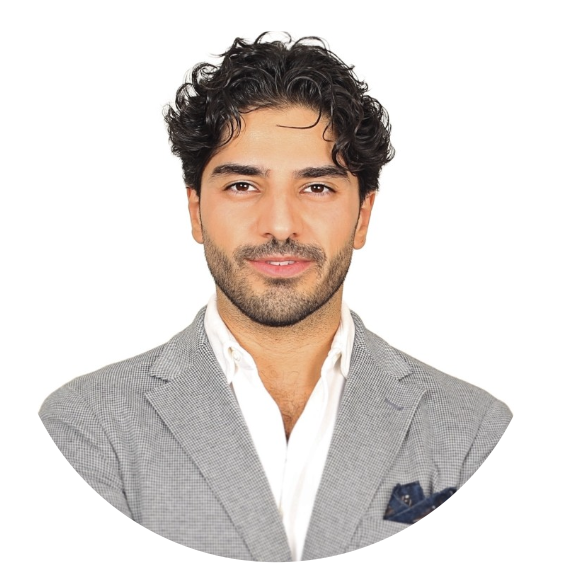
Dariush Salami | POSTDOCTORAL RESEARCHER, AALTO UNIVERSITY | RADIO RESEARCH SCIENTIST, NOKIA BELL LABS
Dr. Dariush Salami works at the intersection of artificial intelligence, wireless communication, RF sensing, wearable computing, and embedded intelligence. He received his doctorate from Aalto University for Spectrum-aware Human-Centric Sensing (HCS) using mmWave radars, which developed AI- and machine-learning-based methods for human-centric RF sensing. Histhesis received an Aalto University Doctoral Thesis Award. His publications span RF localization, mmWave gesture recognition, radar-based human-computer interaction, and integrated sensing and communication. A former Marie Sklodowska-Curie fellow, Dr. Salami is the CEO of SensWear, an open, modular, and AI-ready wearable platform that exposes raw synchronized data, configurable Zephyr firmware, and interchangeable sensing modules. He has taught in Aalto’s Machine Learning D course and teaches wearable-AI concepts through Aalto University Summer School. In this tutorial, he will lead the SensWear system introduction, nRF54L15 Channel Sounding pipeline,ring firmware, live visualization, and practical ranging activities.

Yusein Ali | UNIVERSITY LECTURER, AALTO UNIVERSITY
Dr. Yusein Ali, also published as Huseyin Yigitler, is a University Lecturer in Aalto University’s Department of Information and Communications Engineering. He received his doctorate from Aalto University and his B.Sc. and M.Sc. degrees in Electrical and Electronics Engineering from Middle East Technical University. His doctoral thesis, Narrowband Radio Frequency Infer- ence: Physical Modeling and Measurement Processing, studied how received-signal-strength measurements from commodity narrowband radios can reveal human location and activity, with particular emphasis on device-free localization and physiological monitoring. His research spans RF sensing, localization and tracking, ambient backscatter communication, IoT, radio-resource management, wearable mmWave sensing, and multi-antenna systems. He combines this research background with substantial practical experience in commercial em- bedded systems and teaches Basic C Programming and Embedded System Programming of Communication Devices at Aalto. He is leading the development of SensWear as the CTO of the company. In this tutorial, he will lead the Bluetooth LE and Channel Sounding procedure, controller configuration, timing and data-transfer tradeoffs, experiment design and hardware troubleshooting.